


By Owen Magocha
16 October 2026 · 4 min read · Appeals
Overstay bans are one of the most common problems we deal with, and one of the most avoidable. They often happen to people who had every intention of complying: an application stuck at Home Affairs, a cancelled flight, a medical emergency. The law is strict, but there is a way back if you act correctly.
How the ban arises
Section 50(1) of the Immigration Act says that a foreigner who leaves after their visa has expired must be dealt with under section 30(1)(h), which allows them to be declared undesirable. When you leave, the immigration officer at the port issues a Form 19, the declaration of undesirability, recording how many days you overstayed.
Regulation 27(3) of the Immigration Regulations sets the periods:
- an overstay of 30 days or less: undesirable for 12 months;
- an overstay of more than 30 days: undesirable for five years;
- a second overstay within 24 months: undesirable for two years.
While the ban runs you do not qualify for a visa, admission or permanent residence. It attaches to you, not your passport. Getting a new passport does not remove it.
Two routes, often confused
1. Review by the Director-General (section 8(4)). If you think the declaration is wrong, for example the days were miscounted, you had a pending application, or a concession applied to you, you may make written representations to the Director-General within 10 working days of receiving the Form 19. Note: working days, not calendar days. If the Director-General confirms the ban, you have a further 10 working days to appeal to the Minister.
2. Waiver by the Minister for good cause (section 30(2)). Even where the overstay was correctly recorded, the Minister may waive the ground of undesirability for good cause. There is no statutory deadline, so this route remains open after the 10 working days have passed.
Home Affairs handles both through one mailbox: Overstayappeals@dha.gov.za. The Form 19 itself says so.
What to send
Home Affairs lists the documents it requires:
- a written representation explaining what happened and why the ban should be lifted;
- a copy of the Form 19;
- copies of the relevant passport pages, including the photo page;
- proof of a pending application, such as the VFS acknowledgement, if one was pending;
- a medical certificate, if the overstay was for medical reasons.
In my experience a bare letter rarely succeeds. We add evidence that shows good cause and good faith: flight bookings and cancellations, proof of family ties in South Africa, employment or study records, and a clean compliance history. Keep proof of the date and time you emailed the representation, then telephone Home Affairs to confirm it was received.
What counts as good cause
The Act does not define it. Home Affairs itself recognises medical reasons and pending applications. Directives in recent years have also excused disrupted flights and backlogs. Family ties, a long lawful history and circumstances beyond your control all weigh in your favour. A previous overstay weighs against you.
How long it takes
There is no published turnaround time. In practice decisions take from several weeks to a few months. If the decision gives no intelligible reasons or ignores your representations, it can be taken on review to the High Court. In Mtemachani v Director-General (Western Cape High Court, 2023), a critical skills visa case, the court set aside both the Director-General’s and the Minister’s appeal decisions because the reasons were unintelligible and wrong in law. The same principles apply to overstay decisions.
You may read online that the courts have struck down automatic overstay bans. They have not. In 2014 the Western Cape High Court gave interim relief to a few individuals, and the Constitutional Court declined to hear Home Affairs’ appeal, in 2015, but the validity of the bans was never finally decided.
Check whether you are protected before you leave
Several current directives say certain people must not be declared undesirable:
- Directive 7 of 2026: people with pending waiver, long-term visa or appeal applications lodged by 30 March 2026 may leave and return until 30 June 2027 without being declared undesirable. It excludes permanent residence applicants. Carry your VFS receipt and, for appeals, the rejection letter and proof of appeal. If your nationality needs a visa, apply for a port of entry visa before you return.
- Directive 11 of 2026: travellers affected by the Middle East and Gulf airspace closures, until 30 November 2026 or earlier. Appeals for this group go to middleeast.overstay@dha.gov.za.
Even protected travellers have been issued Form 19s at the port. If it happens to you, do not argue at the counter. Keep the form and lodge representations within 10 working days.
Better still, avoid it
Since Directive 13 of 2026, you no longer have to lodge a renewal 60 days before your visa expires. You do still have to lodge it before expiry. If your visa is close to expiring and you cannot leave in time, speak to us before your last valid day, not after.
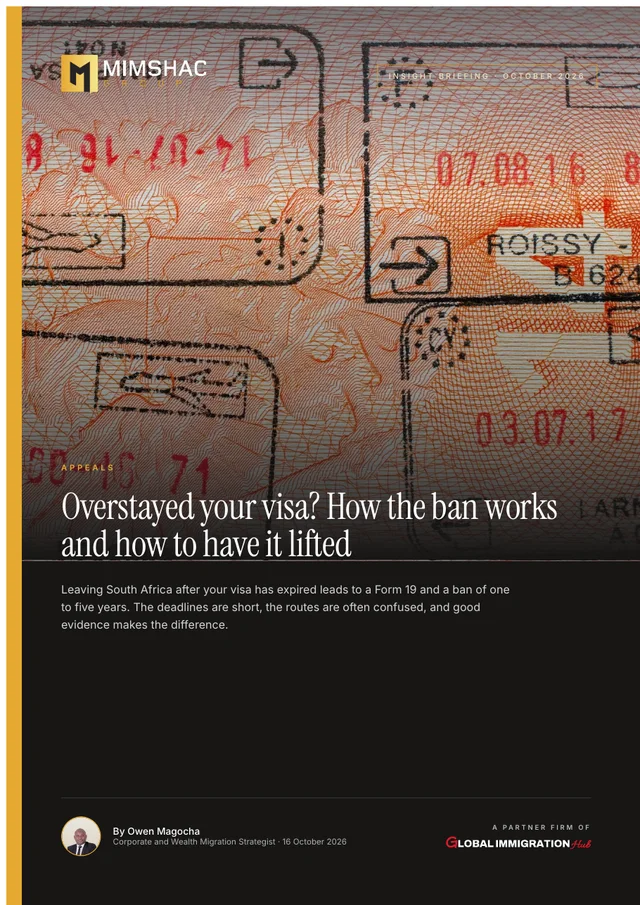
Free PDF briefing · 6 pages
Keep this article as a PDF
A designed briefing to print, keep or share with your family or employer.
Download the briefingRelated services
About the author
Owen Magocha
Corporate and Wealth Migration Strategist, Mimshac Group
Owen leads Mimshac Group’s immigration practice. He holds an LLB from Nelson Mandela University and completed the Legal Profession Admission Board conversion studies for overseas-qualified lawyers through the University of Sydney. He advises multinational employers, families and private clients on South African immigration.
This article is general information on the law and practice as at 16 October 2026. It is not legal advice for your situation, and immigration rules and Home Affairs practice change often. Speak to us before you act.
Sources and further reading
- Immigration Act 13 of 2002 (consolidated, DHA)
- Immigration Regulations 2014, as amended 2018, including Form 19 (DHA)
- Home Affairs: Overstay Appeals
- Immigration Directive 7 of 2026 (30 March 2026)
- Ministerial Immigration Directive 11 of 2026 (30 June 2026)
- Mtemachani v Director-General: Home Affairs [2023] ZAWCHC 318
- Cliffe Dekker Hofmeyr: Directive 7 of 2026 (8 April 2026)
Private question
Ask us privately
Your question goes only to our team, not to the comments. A consultant replies by email, usually within one working day.




Comments
Comments are public and appear once approved. Please do not share personal details or your case. For that, ask us privately.